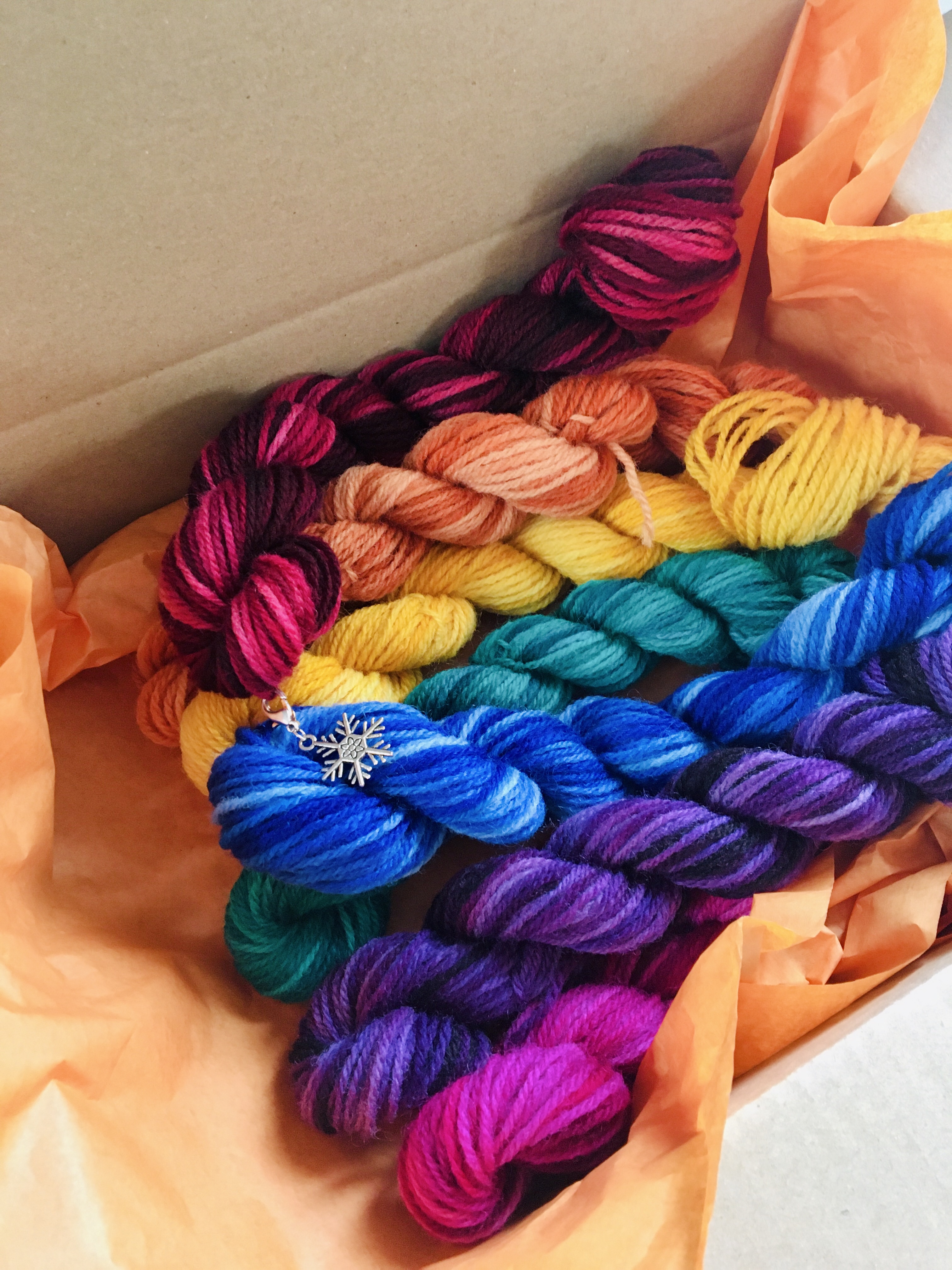

One of the joys of working with hand-dyed or natural yarn is the surprise that happens when you cast on. A skein in the hank might look one way, but once it’s knitted, crocheted, or woven, it can transform into something completely unexpected. Understanding how different colourways behave can help you choose the perfect yarn for your project — or lean into the magic of surprise!

Here are some of the most common colourways and how they knit up, with examples you can try in your own making.
1. Solids and Semi-Solids
- What they are: A single colour (solid) or one shade with subtle shifts in tone (semi-solid).
- How they knit up: Smooth, even colour that highlights stitch definition beautifully. Perfect for lacework, cables, and textured patterns.
- Example: A semi-solid mossy green shawl allows every leaf lace motif to pop, giving the fabric depth without overwhelming the design.
✨ Best for: stitch-heavy projects, garments, or when you want the pattern to take centre stage.


2. Tonals
- What they are: Multiple depths of one hue, hand-dyed to create movement in the fabric.
- How they knit up: Gentle ripples of light and dark create richness. Unlike speckles or variegated, tonals don’t pool or distract.
- Example: A tonal sea-blue jumper gives the impression of shifting ocean waves — subtle, calming, and endlessly wearable.
✨ Best for: timeless sweaters, accessories, or when you want colour interest that’s not too busy.


3. Speckles
- What they are: Random sprinkles of colour on a base shade.
- How they knit up: Flecks of colour dance across the fabric. Depending on needle size and stitch type, speckles can appear as delicate dots or blend into a pointillist effect.
- Example: A cream base with woodland speckles (greens, browns, and golds) looks like wildflowers scattered in a meadow when knit into socks.
✨ Best for: simple stockinette, accessories, or pairing with solids to balance the look.

4. Variegated (High-Contrast)
- What they are: Bold, multiple colours dyed in sections along the skein.
- How they knit up: These can pool (colours stack in blotches), flash (streak across the fabric), or create playful striping depending on stitch count. Every project turns out differently.
- Example: A variegated purple/teal/orange yarn might stripe beautifully in a skinny scarf but pool dramatically in a wide shawl.
✨ Best for: adventurous projects, simple stitch patterns, or when you want the yarn itself to be the star.


5. Self-Striping
- What they are: Dyed in long, repeating sections of colour designed to stripe in predictable bands.
- How they knit up: Perfect stripes appear without any colour changes needed. Width of the stripe depends on the circumference of your knitting.
- Example: Self-striping rainbow socks are a joy to knit — the colour changes keep you hooked row after row.
✨ Best for: socks, hats, and projects where you want cheerful, even colour play.
6. Gradient and Fade Sets
- What they are: Colours shifting gradually from light to dark or one hue into another.
- How they knit up: Creates ombré fabric with gentle flow between shades. When paired as a fade set, the transition feels seamless.
- Example: A gradient shawl shifting from earthy brown to moss green mirrors the landscape of a hillside walk.
✨ Best for: shawls, large wraps, and garments that highlight the colour transition.
Embracing the Magic
The way yarn knits up depends not only on dye technique but also on your stitch pattern, gauge, and project shape. A skein that looks chaotic in the hank may knit into something soft and harmonious — or vice versa!
Tip: If you’re unsure how a yarn will behave, knit a small swatch. Even a 10×10 cm square can reveal whether colours will pool, stripe, or scatter.
Final Thoughts
Choosing yarn colourways isn’t just about what looks pretty in the skein — it’s about imagining how the dye will dance across your stitches. Whether you prefer the calm of semi-solids, the playfulness of speckles, or the drama of variegated skeins, every colourway has a story to tell once it’s on your needles.
So the next time you cast on, lean into the surprise, and let the yarn show you what it wants to be.


Leave a Reply